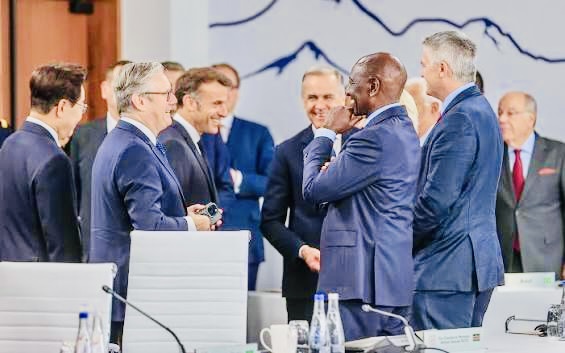
On June 17, 2026, Emmanuel Macron hosted a working lunch in Évian-les-Bains, on the shore of Lake Geneva. The guest list, beyond the assembled G7 heads of state and US Treasury Secretary Scott Bessent, Commerce Secretary Howard Lutnick, and Secretary of State Marco Rubio, included Sam Altman of OpenAI, Dario Amodei of Anthropic, and Demis Hassabis of Google DeepMind. About a dozen tech executives in total sat down with the leaders of the world's most powerful democracies to discuss the future of artificial intelligence governance.
Elon Musk was not there. Neither was anyone from xAI.
This is worth pausing on, not because Musk is owed an invitation, but because of what was actually being discussed in that room and who currently holds the most direct lever over how information reaches people. Amodei and Hassabis pushed for a US-led coalition on frontier model access and chip trade rules. Altman called for an international testing forum with shared safety benchmarks. The session took place six days after Washington had disabled foreign access to Anthropic's Fable 5 and Mythos 5 models entirely, an episode covered in detail elsewhere on this site. Macron, addressing the room, warned that nobody will buy American AI if they fear it can be switched off at any moment.
That is precisely the right question to ask about model access. It is a strange one to ask in a room that excluded the person who already controls, switch included, the platform that shapes more real-time political discourse than any model under discussion.
![[Image: the empty seat — add caption]](musk-table-absence.jpg)
Reach Versus Model Size
The case for X belonging in a room about AI governance has nothing to do with whether Grok is the largest model. It isn't, and nobody seriously argues it is. The case rests on distribution. X remains, by any reasonable measure, the platform with the most direct, least-mediated influence on real-time political discourse of any social network currently operating at scale. Decisions about how its algorithm ranks, amplifies, or suppresses content shape what hundreds of millions of people believe is happening in the world, in a way that a frontier language model's raw capability score does not, at least not yet, and not as directly.
A summit about who controls the information environment that AI governance is meant to operate inside of had a hole in it exactly where the most consequential current answer to that question would have sat.
The Six Weeks Before Évian
The absence does not require speculation about Macron's personal feelings toward Musk. There is a documented, sourced reason sitting in plain view, and it predates the summit by months.
The Documented Sequence
X's own Global Government Affairs account responded to the February raid directly: the action was "an abusive act of law enforcement theater designed to achieve illegitimate political objectives." Musk has separately called the broader probe a "politically-motivated criminal investigation." Both statements are on the record and represent X's position that the legal pressure is retaliatory rather than substantive.
Sources: X Global Government Affairs, February 2026; Reuters/AP wire coverage, February and May 2026
Whatever the merits of the underlying investigation, and ETH takes no position on guilt here, the sequence is not ambiguous. By the time the G7 convened, Musk had already failed to appear for a French judicial summons for nearly two months, and the matter had escalated from inquiry to formal criminal investigation. A head of state hosting a working lunch on his own soil, six weeks after the man's own prosecutor's office moved his case from witness summons to judicial investigation, had a documented reason not to extend that invitation. The absence is explainable without recourse to personal animus. It tracks the legal record precisely.
![[Image: the Paris investigation — add caption]](musk-table-paris.jpg)
The Same Week, A Subsidised Alternative
The G7 exclusion did not happen in isolation. The same week, the European Commission officially migrated its public communications to W Social, a Swedish-incorporated platform requiring NFC passport scans for participation, financially backed in part by Belgium, and carrying its own unresolved disclosure and governance questions, covered in full in Paper Sovereignty, Real Scan. The Commission's own posts announcing the migration were, notably, still published on X.
Read together, the pattern is not "Musk was personally snubbed." It is closer to: European and allied institutions are simultaneously applying legal pressure to the dominant, US-based, individually-controlled information platform, while funding and promoting a controlled, identity-verified alternative, while excluding the dominant platform's operator from the room where the rules governing the next layer of information infrastructure, AI, are being written. None of these three things requires the others to be true. Together, they describe a single strategy: contain the platform you cannot own, and build the one you can.
Nobody at that table controls more of how political reality reaches people right now than the person who wasn't there. That is not a coincidence to be explained away. It is the most informative fact about the lunch.
What This Adds to the Picture
The previous piece in this loosely connected set, There Is No Country to Use as a Basis, argued that no current actor holds both the will and the productive capacity to counterbalance US frontier AI policy, and that what allies produce instead is theater for domestic audiences. The G7 exclusion adds a sharper, more specific version of the same finding. It is not only that Europe lacks the compute to set terms with Washington. It is that Europe, France specifically, is willing and able to exert real legal pressure on a platform it does not control, while simultaneously funding a platform it hopes to. Capacity is not evenly distributed. France has genuine leverage over Musk through its courts. It has none over the compute gap. Both facts were visible in the same week, in the same country, eighty kilometres apart.
The question this leaves open is not whether the French investigation is justified. It is whether anyone currently has a coherent answer to who governs the platform that already shapes political reality at scale, while everyone in the room was busy writing rules for the platforms that might do so next.
Sources & Primary References
- CNBC, 17 June 2026: "CEOs of Anthropic and Google DeepMind call for U.S.-led AI coalition in meeting at G7" — full attendee list including Bessent, Lutnick, Rubio
- CNBC, 17 June 2026: "AI in spotlight at G7 as Trump, world leaders joined by tech chiefs"
- Fortune, 17 June 2026: "The G7 has some special lunchtime guests this year" — Macron quote on AI access reliability
- Wikipedia, 52nd G7 summit: dates, venue, host confirmation
- CNBC, 3 February 2026: "Paris prosecutor's cybercrime unit searches X office, Musk summoned"
- Al Jazeera, 3 February 2026: raid details, expanded charges, X's "law enforcement theater" statement
- CNBC, 7 May 2026: "French prosecutors escalate probe of Elon Musk and X to criminal investigation" — confirms Musk and Yaccarino declined the April 20 summons
- TechPolicy.Press: machine translation of Paris Prosecutor Laure Beccuau's 6 May 2026 statement opening the judicial investigation, full charge list
- Malay Mail, 3 February 2026: Éric Bothorel complaint origin, January 2025 investigation opening
- Related ETH investigations: There Is No Country to Use as a Basis · Paper Sovereignty, Real Scan
Read the Connected Pieces
Three readings of the same week, from three different angles.
There Is No Country to Use as a Basis → Paper Sovereignty, Real Scan →