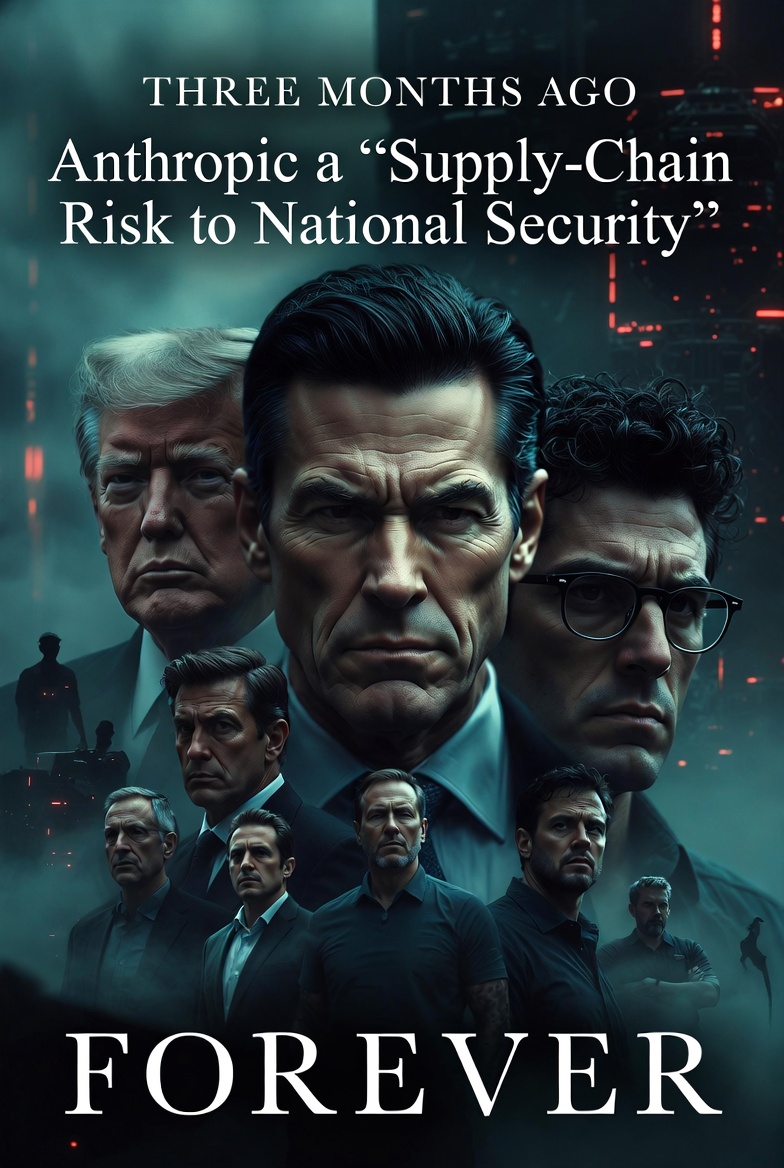
June 13, 22:40. US Secretary of Defense Pete Hegseth, posting to 603,000 views: "Three months ago, @DeptofWar kicked @AnthropicAI out of our building, forever. Every passing day proves why that was the right move."
That post has nothing to do with Brussels. Nothing to do with the DMA, Apple, or European digital sovereignty. It is the United States Secretary of Defense, the day after Fable 5 and Mythos 5 went dark for the entire planet, taking a victory lap on a fight that started in February.
Source: @PeteHegseth, X, 13 June 2026, 22:40, 603K views
![[Image: Timeline — add caption]](three-months-forever-timeline.jpg)
Four Months, Not One Week
The published piece documented the June 12 directive as a collision between two regulatory logics, one European, one American, with EU users caught in both. That collision is real. But the directive itself was never primarily about either of those things. It was the latest move in a four-month domestic argument over who gets to set the safety limits on America's most capable AI, fought in public between a cabinet department and a single company.
The Argument Before the Argument
Every non-US user, including everyone in the EU, inherited the outcome of an argument they were never party to, about a question, should the military get AI without human oversight on lethal force and domestic surveillance, that they were never asked.
Visible at Every Step
There is something genuinely new in how this is happening. Past technology transitions, nuclear, early cryptography export controls, played out mostly behind classification. This one is happening in the feed. A Secretary of Defense gloating in real time, a CEO's statement, a court injunction, an export directive, all visible, all timestamped, all four months apart and all colliding in one week. The institutions are improvising in public, and you can watch an administration sign a memo to accelerate AI on a Friday and disable the most advanced AI on the planet the following Friday.
The institutional clock is wrong everywhere. Brussels was never going to be in this room, because the room itself was improvised, four months in the making, and aimed at something else entirely.
Built It, Can't Use It
One detail worth sitting with: the foreign-national restriction in the June 12 directive lands on several of the people whose careers built the safety research the directive claims to be protecting. People who spent years on the question of how to make these systems safe now cannot access the systems they helped make safe, because of where they were born. Whatever the directive is actually targeting, it does not appear to distinguish between that and this.
What This Adds
The published piece found that the EU holds roughly 5% of global AI compute and regulates products it does not produce at the frontier. This adds a sharper edge to that finding. The mismatch is not only that some actors lack productive capacity. It is that even the country with the capacity is visibly struggling to build governance at the speed the technology moves, producing contradictory policy within the same administration inside a single week.
This is not a one-off. The Anthropic/Pentagon relationship has been an open, escalating, publicly fought argument since February, and the June 12 directive reads less like a new event than like the next scheduled instalment. Expect more.
Sources & Primary References
- Pete Hegseth (@PeteHegseth), X, 13 June 2026, 22:40 — "Three months ago, @DeptofWar kicked @AnthropicAI out of our building, forever."
- Associated Press: Trump orders US agencies to stop using Anthropic technology in clash over AI safety
- Fortune, 6 May 2026: Trump administration suddenly embraces AI oversight ideas it once rejected
- Center for American Progress: The Trump Administration Is Trying To Make an Example of the AI Giant Anthropic
- Council on Foreign Relations, 9 June 2026: What Trump's National Security AI Memo Gets Right, and Leaves Unresolved (NSPM-11)
- The Hill: Anthropic restricts latest AI models in compliance with Trump admin directive
- Companion piece: The AI Governance Wars Begin — Echo Truth Hub, 13 June 2026
Read the Full Investigation
This supplement assumes the EU/US regulatory analysis in the main piece. Start there for the global picture, then come back here for the domestic fight underneath it.
The AI Governance Wars Begin → Follow ETH on X →