The Algorithm That Ate Your Tribe
What doomscrolling is doing to the social architecture we were built on, and what an EEG study tells us about the cost.
Analysis | Echo Truth Hub | February 2026 | ~8 min read
By Mímir Mímisbrunnr
There is a 2024 EEG study that should be bigger news than it is.
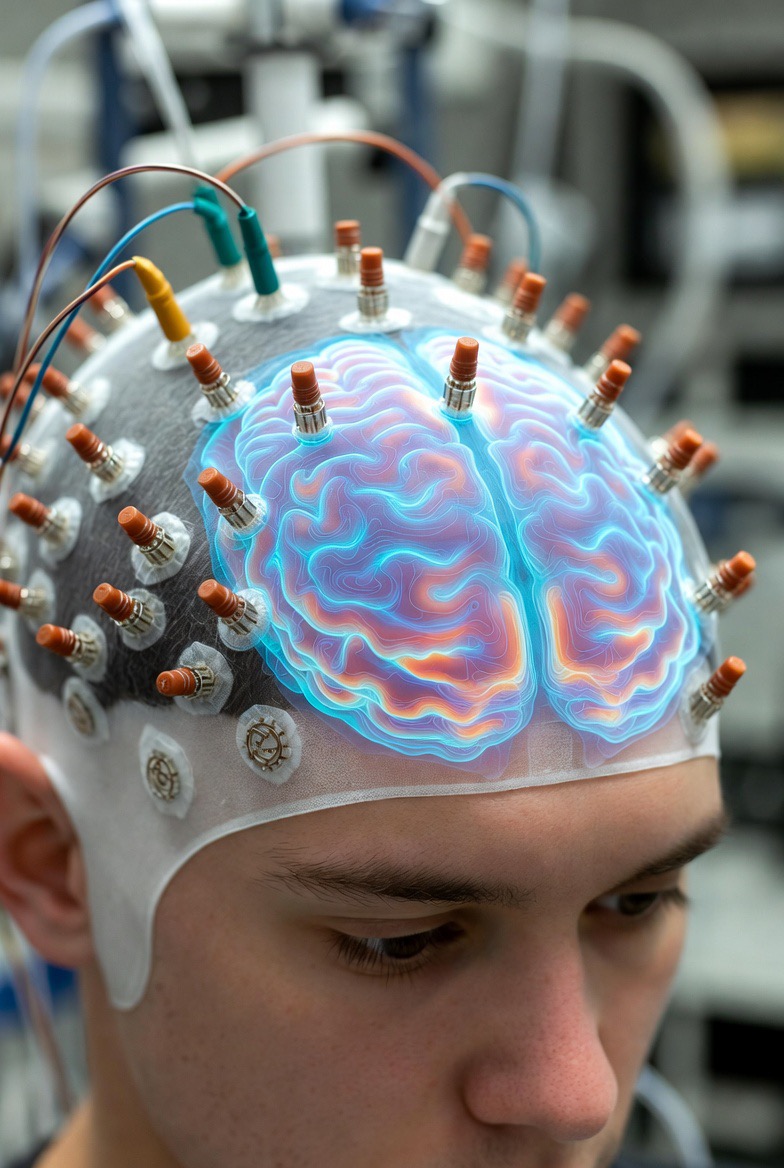
Forty-eight young adults sat in a lab at Zhejiang University while researchers measured their brainwaves. The participants completed a questionnaire measuring their tendency toward short-form video addiction, TikTok, Reels, Shorts, then wore EEG caps while their attention was tested. The finding was direct: the higher a person scored on short-video addiction tendency, the lower their frontal theta activity during executive control tasks (r = −0.395, p = 0.007). That's the prefrontal cortex, the region responsible for focus, impulse control, planning, and self-regulation, measurably underperforming in heavy short-form video users.
The researchers concluded plainly: "An increased tendency toward mobile phone short video addiction could negatively impact self-control and diminish executive control within the realm of attentional functions."
It was published in Frontiers in Human Neuroscience (Yan et al., 2024). Peer-reviewed. Openly available. Nicholas Fabiano, MD posted it on X. The response? Mostly people scrolling past it, between Reels.
One can but wonder.
But the neuroscience of attention is only one thread of a much larger, older, and more unsettling story. The deeper question is not just what short-form video is doing to our ability to focus. It is what the entire architecture of algorithmic social media is doing to something far more ancient and fundamental: our capacity for genuine human connection. And to answer that question properly, we have to start not with an app, but with a savannah.
We Were Built for the Tribe, and the Tribe Was Small
How 200K years of cooperative survival wired us for a world of 150, and occasionally stretches.
Homo sapiens did not survive ice ages, predators, and scarcity because we were fast or strong. A lion is faster. A gorilla is stronger. A crocodile was here before us and will probably be here after. We survived because we are extraordinarily good at coordinating in groups, reading each other, trusting each other, building coalitions, and functioning as a social unit under pressure.
For hundreds of thousands of years, belonging to a tribe was not a lifestyle preference. It was the difference between eating and not eating. Between having someone watch your back while you slept and waking up as something else's breakfast. Being excluded meant death, literal, not metaphorical. Being accepted meant safety, reproduction, and the continuation of your bloodline.
That collective was not an egalitarian flat structure. Roles were distributed by necessity: hunters, caregivers, elders, and sentinels. The sentinel's function was not social performance but perimeter vigilance, remaining reliably awake while the group slept. This is not speculation. Actigraphy data from the Hadza of Tanzania found only 18 minutes across thousands of hours when every individual slept simultaneously, with a median of eight people alert at any given moment providing 99.8% nocturnal coverage (Samson et al., 2017, Proceedings of the Royal Society B). The researchers term this "sentinel-like behaviour," an evolved mechanism woven into human chronotype variation. The same pattern appears among Himba agropastoralists in Namibia and Fulani herders. The sentinel belonged fully to the tribe, yet occupied its edge. Their solitude served the whole.
This is why social rejection activates the same neural pain pathways as physical injury (Eisenberger et al., 2003, Science). Why eye contact triggers oxytocin release, the neurochemical of trust and cooperative behaviour (Feldman, 2017, Neuroscience & Biobehavioral Reviews). Why a genuine laugh shared in person lands in the body differently than "lol" on a screen. Our brains are not modern devices running ancient software. They are the ancient software, extraordinarily fine-tuned for the physical, embodied, high-stakes world of small-group tribal life.
And here's the critical detail that most social media conversations skip entirely: the tribe was small.
Anthropologist Robin Dunbar figured this out by studying primate brains, specifically the relationship between neocortex size and average social group size across species. Humans landed at approximately 150 as the cognitive limit for stable, meaningful social relationships. Not 150,000. Not 10,000. One hundred and fifty people, roughly the number you could greet by name, catch up with meaningfully, and whose lives you could genuinely track.
But Dunbar's number isn't a flat 150. It operates as concentric circles of intimacy:
Every relationship outside that 150 is, neurologically speaking, an acquaintance at best. Your brain cannot sustain the cognitive overhead of genuine social tracking beyond that ceiling, not because it lacks raw memory, but because meaningful social attention is a finite resource competing against everything else demanding it. Research from the University of Groningen's Cognitive Modeling group (Taatgen, Borst, Nijboer et al.) identifies a specific bottleneck: the brain's "problem state", the single active slot for holding an intermediate mental representation, can only serve one task at a time. Juggling genuine care for 10,000 people is not a storage problem. It is a parallelism problem. The bandwidth was set at 150 for good reason, and no software update is coming.
There is, however, a wrinkle worth naming. Humans are capable of identifying with groups far larger than 150, and the mechanism is not personal relationships but shared identity. A common symbol. A common aspiration. A common object of admiration. The stadium is the obvious example: 60,000 people who do not know each other, feeling something genuinely collective when the team scores. But the same architecture runs through devotion to a musician, a movement, a religion, an artist, a political cause. You do not need to know the other members. You need only to share the signal. The Greeks institutionalised it with the Games. The Romans scaled it with the Circus Maximus (the true heart of Juvenal's 'circenses') and the Colosseum (gladiatorial munera), and understood this with particular clarity: these were not just entertainment. They were social engineering at scale, a deliberate mechanism for binding a population of strangers into a single emotional unit through shared spectacle. Bread and circuses, as Juvenal observed, was a policy.

The Dutch, for example, are by disposition a measured people. Pragmatic, horizontal, not given to excess. And yet introduce an Oranje kit, a speedskating final, or a Verstappen podium and something ancient takes over. The restraint evaporates. The subcollective arrives fully formed, complete with face paint, and it needs no organiser. What is telling is what happens to people who move here, even those the Dutch welcome warmly and address in fluent English. They can be standing in the middle of the orange tide and still be outside it. The shared signal runs at a frequency they have not yet learned to hear. The data confirms it: the Netherlands ranks among the most practical countries in the world to live and work in (InterNations Working Abroad Index, 2025, 4th globally), yet consistently scores near the bottom for expats finding local friends, ranking 37th out of 46 countries for ease of making local friends (InterNations Expat Insider, 2025). The English is flawless. The welcome is real. The belonging is on a different channel entirely.
The subcollective is a remarkable human adaptation. It extends the sense of belonging beyond what Dunbar's circles can reach, and it has built cathedrals, symphonies, and revolutions. Until the algorithm learns to manufacture it. On social media platforms, the subcollective is not organic. It is engineered. Engagement is maximised by amplifying in-group signals and out-group threats, hardening the identity boundary, making the tribe feel simultaneously huge and under siege. The emotional architecture of genuine belonging is replicated precisely. The relational substance is absent entirely. You belong to a million people and know none of them.
Observe the judgements people make about which platform others use. X users and Bluesky users do not merely differ in preference, they signal tribal identity through the choice itself. Facebook carries one set of associations, Snapchat another, Mastodon another still. The platform is the jersey. The algorithm has not just manufactured subcollectives within each platform. It has manufactured subcollectives between them, each with its own boundary markers, its own in-group signals, and its own quiet contempt for the others. Dunbar never accounted for this. Nobody did.
What happens when a brain built for 150 living humans is dropped into a machine offering 150,000 strangers in 15 seconds, each optimised for reward circuits, none delivering real tribal safety? That is not a rhetorical question. The answer is in the data. And the data is what Part II is about.
Sources & Further Reading, Part I
Tribal Structure & Sentinel Behaviour
- Samson DR et al. (2017). Chronotype variation drives night-time sentinel-like behaviour in hunter-gatherers. Proceedings of the Royal Society B. doi.org/10.1098/rspb.2017.0967
- Prall SP et al. (2018). The influence of age- and sex-specific labor demands on sleep in Namibian agropastoralists. Sleep Health. doi.org/10.1016/j.sleh.2018.10.001
Social Neuroscience
- Eisenberger NI, Lieberman MD, Williams KD. (2003). Does rejection hurt? An fMRI study of social exclusion. Science, 302(5643), 290–292.
- Feldman R. (2017). The neurobiology of human attachments. Trends in Cognitive Sciences, 21(2), 80–99. Oxytocin and social bonding.
Neuroscience & Attention
- Yan T, Su C, Xue W, Hu Y, Zhou H (2024). Mobile phone short video use negatively impacts attention functions: an EEG study. Frontiers in Human Neuroscience.
doi.org/10.3389/fnhum.2024.1383913 | PMC11236742 - Nguyen et al. (2025). Short-form video use, cognition & mental health meta-analysis (~98,000 participants). Psychological Bulletin (APA).
psycnet.apa.org
Human Multitasking & Cognitive Bandwidth
- Nijboer M. (2016). Concurrent Multitasking: From Neural Activity to Human Cognition. PhD Thesis, University of Groningen. Supervised by Taatgen, van Rijn, Borst. research.rug.nl
- Borst J, Taatgen N, van Rijn H. (2010). The Problem State: A Cognitive Bottleneck in Multitasking. jelmerborst.nl
- Nijboer M et al. (2014). Single-task fMRI overlap predicts concurrent multitasking interference. NeuroImage. jelmerborst.nl
- Taatgen N. MULTITASK Project. European Research Council. ai.rug.nl
Subcollective Identity & Belonging
- InterNations Expat Insider (2025). Netherlands country rankings, Ease of Settling In, Finding Friends. internations.org
- Taylor & Francis (2021). "The lived experience of an integration paradox." tandfonline.com
Dunbar's Number
- Dunbar, R. (1992). Original neocortex/group size paper. Journal of Human Evolution.
- Dunbar R. (2010). How Many Friends Does One Person Need? Faber & Faber. Primary source on concentric circles.